Race, Rivalry and Revenue
Race, Rivalry, and Revenue
How Earvin “Magic” Johnson and Larry Bird Saved the NBA
The United States is home to the most sports-obsessed culture in the world. Its sports-entertainment industry produces enough economic activity to rival a small nation. Its greatest professional athletes are A-list celebrities. Its most popular professional leagues generate billions annually. It is home to the 4 of the top 5 highest-grossing leagues in the world. Its largest college athletic programs generate over $100 million annually. All of this is not to mention the media corporations which generate billions each year just for writing and talking about sports.
For the National Basketball Association (NBA), two players stand above the rest in terms of their importance to the viability of the league: Earvin “Magic” Johnson and Larry Bird. Bird and Johnson’s rivalry was the central narrative in the NBA throughout the 1980s - a decade that saw the league grow dramatically in popularity (Surdam).
Before Johnson and Bird joined the league, television ratings were declining and broadcasting companies favored airing the nightly news over live playoff games (Jozsa). Once they set off on their respective careers, however, the NBA began its ascent into one of the most popular leagues on the planet.

While race can be a challenging subject to consider, it is impossible to explain why Johnson and Bird captivated such attention without understanding the implications that Johnson is black and Bird is white. It is integral to their story. Before analyzing the impact of race on the men’s rivalry, however, it is important to note how uniquely intertwined the men’s careers were.
Where It Began
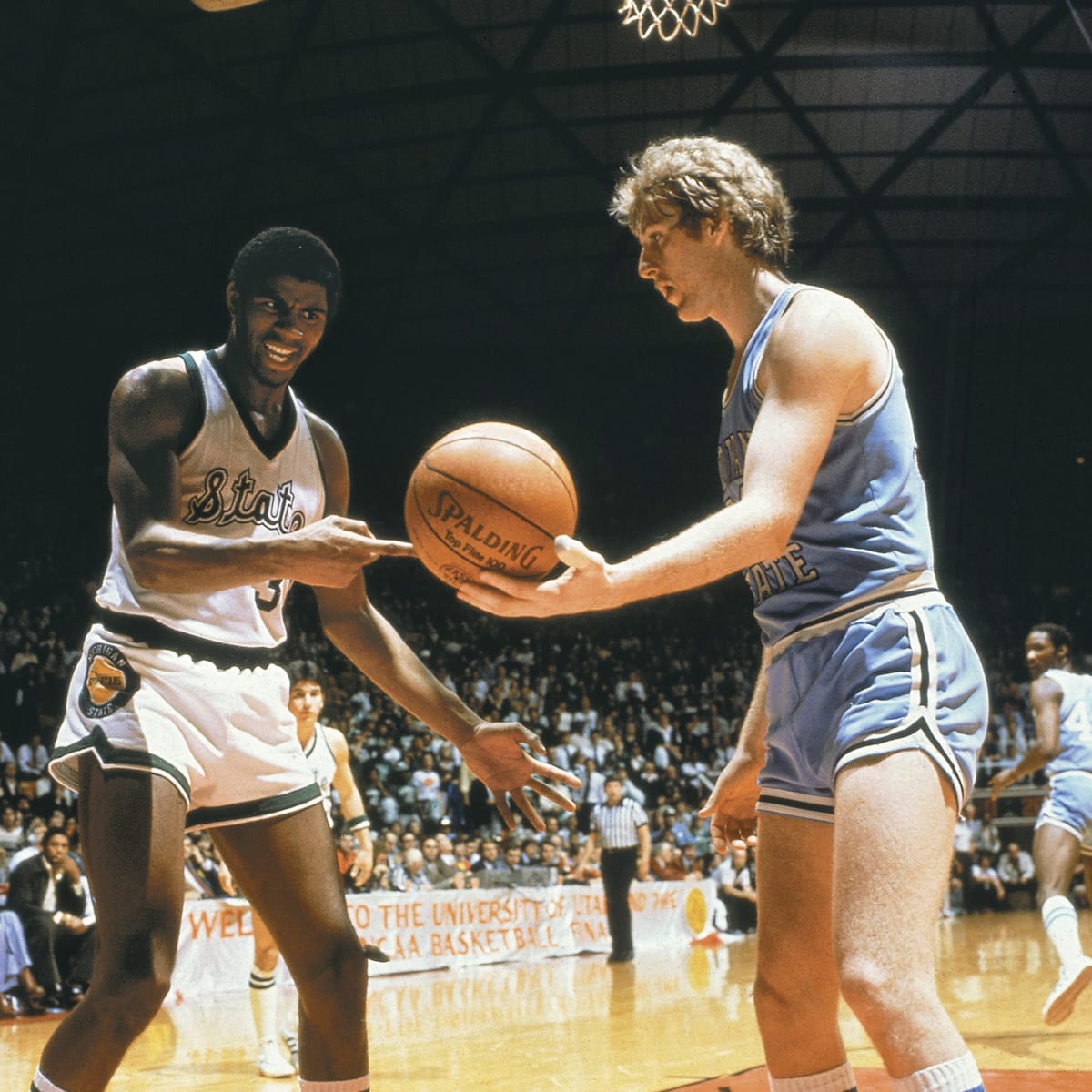
The attention that these two players would command in the NBA was foreshadowed during their time in college. The first game they ever played against each other was in the NCAA national championship of 1979, “a contest that still stands as the highest-rated [televised] basketball game of all time” (Nelson, 2015). So it’s fair to say that they got off to a hot start. Johnson and Michigan State beat Bird and Indiana State before the pair went off to the NBA for their rookie seasons.
Where It Continued
Johnson was drafted by the Los Angeles Lakers, Bird by the Boston Celtics (Ferucci). By the time they entered the league for the 1979-80 NBA season, the Lakers and the Celtics had already established themselves as the premier rivalry in the league (Bradley). They had spent the previous decades competing for championship titles, so when Bird and Johnson came along, their teams’ lasting success was nothing new.
That success was remarkable, however.
In their very first season as professionals, Bird won the rookie of the year award, while Johnson won a championship and Finals Most Valuable Player award. Johnson went on to win 5 championships, 3 MVPs, 3 Finals MVPs, and numerous other accolades. Bird went on to win 3 championships, 3 MVPs, 2 Finals MVPs, and likewise earned many other honors. Both were inducted into the hall of fame (Surdam).
Why It Mattered: Skill
While their accomplishments are reflective of their successful careers, people were not interested in them because of their trophy cases, people were interested in them because of their one-of-a-kind skills.
Earvin Johnson is not known as “Magic” because of his ability to pull a rabbit out of a seemingly empty hat. He is called “Magic” because of his spectacular highlights on the basketball court. At 6-foot 9-inches tall, he played point guard - a position traditionally suited for the much shorter players - better than anyone in the history of the NBA before or since. His passing ability is widely regarded as the greatest ever, and his high tempo fastbreak-centric style of play was the catalyst for one of the most potent offenses the sport has ever seen: one which earned its own nickname as “Showtime”.
Larry Bird was an equally unique player. While he couldn’t run a fastbreak like Johnson, Bird also has sensational passing skills and was an elite scorer from every distance - he could shoot three-pointers, mid-range jump shots, and layups all with great efficiency. Both Bird and Johnson were the conductors of their teams’ high-performing offenses.
Why It Mattered: Race
Like “Magic”, Bird was given (or more accurately burdened with) a nickname: “The Great White Hope” (Ferucci). The majority of NBA players have been black Americans since soon after the league became desegregated, so Bird’s success would likely have inspired racial tensions regardless of his rivalry with Johnson. In combination with the rivalry, however, white Americans identified Bird as a savior figure - in opposition to Johnson (and black Americans implicitly). Black Americans could likewise identify with Magic Johnson in opposition to Bird (and white Americans).
Although I equate these groups, I do not believe that the existence of racial animosity is equally justified among them. It is beyond unfortunate that past generations' horrific sins continue to impact our world to this day - to the benefit of some and the detriment of others, let it not go unsaid. But, for the purpose of accurately reflecting Johnson and Bird's impact on the NBA and in American culture, it must be addressed.
“For a generation of sports fans, Johnson and Bird embodied the cultural and athletic differences between black and white players. Off the court, the two athletes became good friends, but cultural pressures dictated that fans choose between the two, with even the vast majority of white Angelenos rooting for Bird and black Bostonians for Johnson” (Ferucci).
Tribalism is a part of human nature. Racial tribalism is a part of American history, if not its most tragically enduring theme. Johnson and Bird had no choice in being representatives of black and white America. They were simply incredible basketball players whose careers wove together like a children’s storybook, a storybook so fascinating that it was instrumental in the revival of a multibillion-dollar enterprise.
Works Cited
Bradley, Ken, and Sean Deveney. “Lakers Vs. Celtics: ‘It’s the Way It Should be.’(Los Angeles Lakers Vs. Boston Celticsin the 2010 NBA Finals).” The Sporting News, vol. 234, no. 14, Sporting News Publishing Co, 2010, p. 48–.
Ferrucci, Patrick, and Earnest Perry. “Double Dribble: The Stereotypical Narrative of Magic and Bird.” Journalism History, vol. 41, no. 2, Routledge, 2015, pp. 93–102, doi:10.1080/00947679.2015.12059221.
Jozsa, Frank P. The National Basketball Association Business, Organization and Strategy . World Scientific, 2011.
Nelson, Murray. “Larry Bird vs. Magic Johnson, 1979.” Replays, Rivalries, and Rumbles: The Most Iconic Moments in American Sports, edited by STEVEN GIETSCHIER, University of Illinois Press, Urbana; Chicago; Springfield, 2017, pp. 153–160. JSTOR, www.jstor.org/stable/10.5406/j.ctt1ws7w3w.22. Accessed 15 June 2021
Surdam, David G. The Rise of the National Basketball Association. University of Illinois Press, 2012.
Comments
Post a Comment